






High Grade Waste Heat Recovery
- Scrap Preheating with Electric Arc furnace Exhaust
- Regenerative Burners for Reheating Furnaces
- Recuperator
Continuous Scrap preheating system
Electric arc furnace involves a high-temperature melting operation. The average temperature of the melt inside the furnace is about 1650 °C. The waste gases or off-gases from the furnace leave at about 900-1200 °C, which is quite high, wasting significant energy. About 20% of the input energy is carried away by the off-gases. This waste heat available in off-gases can be effectively recovered and reused which would help in reducing the overall energy consumption of the furnace. One of the major options for WHR is preheating input scrap. The exact energy savings depend on the type of scrap, size, the temperature of off-gases and residence time.
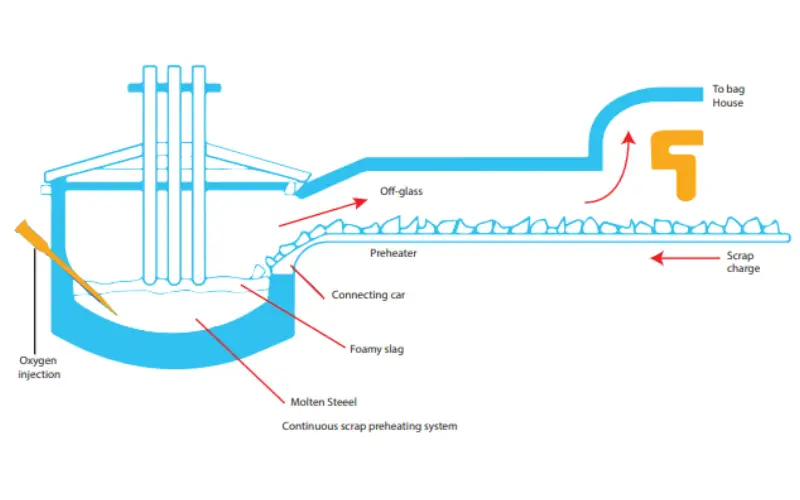
The most established scrap preheating technologies applicable for EAFs are:
- Bucket preheating system
- Continuous scrap preheating system
Regenerative Burners for Reheating Furnaces
- The regenerative burners fire alternately to recover the sensible heat from waste gas for the preheating of combustion air.
- The systems are capable of obtaining high-temperature preheated air exceeding 1100℃ in a short timeframe, by repeated heat accumulation and combustion.
- Recover between 85 -90 % of the heat from the furnace waste gases
- Application temperatures range from 1100oC up to 1500 °C.
- Fuel consumption can be reduced by up to 60 %.
- Used for Melting/Reheat/Treatment Furnaces, & kilns
Recuperator
In a recuperator, heat exchange takes place between the flue gasses and the air through metallic or ceramic walls. Ducts or tubes carry the air for combustion to be preheated, the other side contains the waste heat stream. Recuperators are classified based on the principle of heat transfer by radiation, convection, or combinations. Recuperators are constructed out of either metallic or ceramic materials. Metallic recuperators are used in applications with temperatures below 1050 °C, while heat recovery at higher temperatures is better suited to ceramic tube recuperators which can operate with hot side temperatures as high as 1500 °C and cold side temperatures of around 950 °C. For maximum effectiveness of heat transfer, hybrid recuperators are used.